OpenAI spent its first three years insisting that ChatGPT would never carry advertising. That position did not survive contact with the economics of running the most used consumer AI product in the world. In January 2026 the company confirmed it would begin showing ads inside ChatGPT, and it started testing them the following month. For anyone who buys media for a living, this is the most significant new advertising surface in years, and it behaves nothing like the channels that came before it.
This guide sets out how the ChatGPT ad system actually works: where ads appear, who sees them, how targeting and pricing are built, how much OpenAI expects to make, and, just as important, what the platform still cannot do. The picture is moving quickly and some of the detail below is drawn from reporting rather than official documentation, so treat the specifics as a snapshot of a system that is still being assembled.
What are ChatGPT ads, exactly?
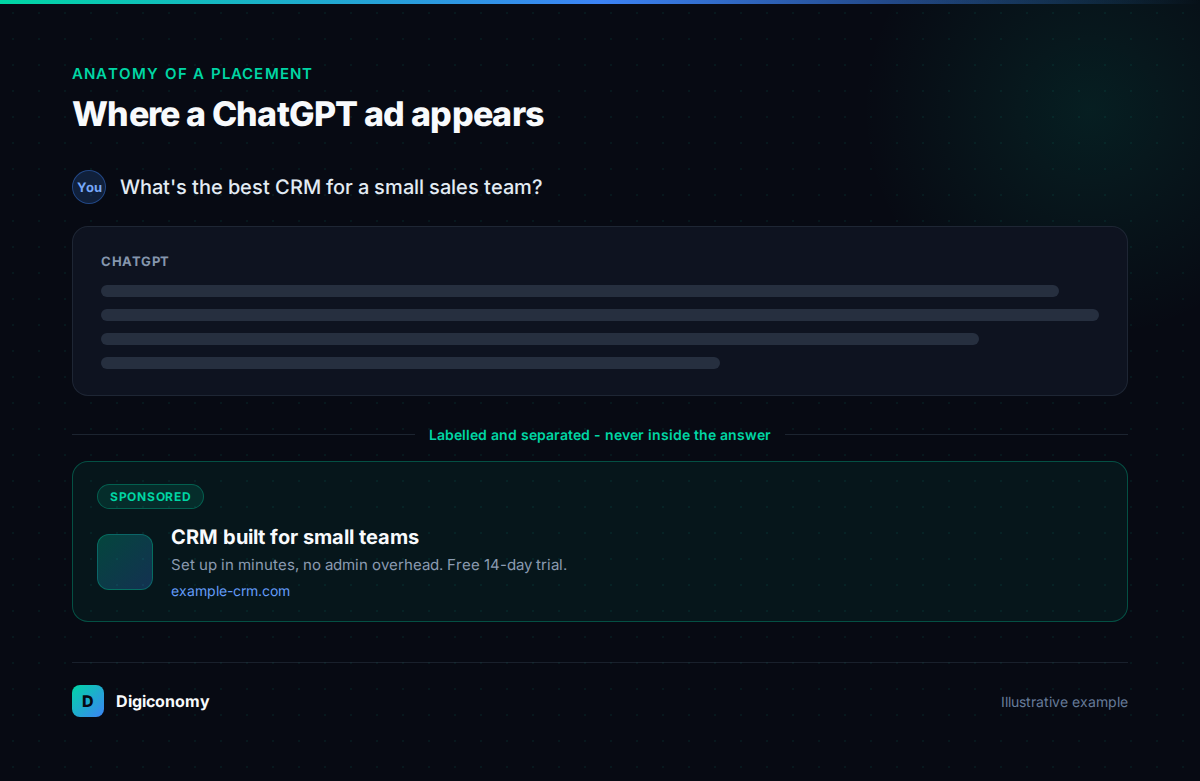
A ChatGPT ad is a paid placement that appears below the assistant's answer, in a clearly labelled, visually separated card. It never sits inside the answer itself. When you ask ChatGPT to compare running shoes or recommend a project management tool, the response is generated as normal, and a sponsored card may then appear beneath it as an optional next step.
The design principle OpenAI has been most explicit about is the separation between the answer and the advert. Fidji Simo, who joined OpenAI in August 2025 to run its consumer applications, put it plainly: "Ads will not influence the answers ChatGPT gives you." That promise is the foundation the entire model rests on. The moment users suspect that spending money changes what the assistant recommends, the trust that makes ChatGPT useful starts to erode, and with it the value of the ad inventory.
This is what makes the placement genuinely different from search or social ads. It arrives at the end of a research conversation, at the point where a user has already described what they want in detail and is closest to a decision. There is no feed to scroll past and no ten blue links to compete with. The trade-off is that the surface is small, the volume of eligible impressions is capped by how often a conversation is commercial, and the tolerance for anything that feels intrusive is very low.
Who actually sees the ads
Ads are shown only to people on the free tier and the lower-cost Go tier. Subscribers on Plus, Pro, Business, Enterprise and Education do not see them. OpenAI has been consistent that subscriptions remain its long-term priority, and that the paid plans stay ad-free precisely because that is part of what people are paying for.
For advertisers, that split matters more than it first appears. The reachable audience skews towards lighter and non-paying users, while the heaviest power users - often the most valuable in a B2B context - sit on paid plans and cannot be reached through ads at all. If your buyers are senior professionals who live in ChatGPT Pro all day, the ad system will not put you in front of them. If you sell to a broad consumer or early-stage audience, the reachable base is very large and growing.
How the ad format works
The core unit is a compact card. Early reporting describes a headline of roughly 50 characters, a description of around 100 characters, an image or favicon, and a link through to the advertiser's site. It is closer to a text ad than a rich display banner, which suits the conversational context and keeps the placement from overwhelming the answer above it.
For retailers, OpenAI has added a product feed feature: you upload a full catalogue and the system generates ads automatically rather than making you build each one by hand. This is the same pattern that made Shopping and Performance Max scalable for e-commerce, and it signals that OpenAI wants catalogue-driven advertising to work at volume, not just single hand-built placements.
The more interesting formats are the ones still in development. OpenAI has signalled interactive, conversational ads, where a user can ask the assistant questions about a product directly, and in-chat checkout that lets someone buy in a single step without leaving the thread. The direction of travel is clear: from a static card, towards a transaction that happens inside the conversation. That is a very different proposition from sending a click to a landing page and hoping the funnel holds.
How targeting works, and why it is different
There is no keyword auction in the sense paid-search teams are used to. Instead, advertisers provide what OpenAI calls "context hints": short descriptions of the kinds of conversations where a product is relevant. The system matches ads to the live topic of the current thread rather than to an exact-match term someone typed into a box.
On top of that contextual layer sits optional personalisation. If a user has not opted out, OpenAI may draw on additional signals to improve relevance: past chats, saved memory, and how the person has engaged with previous ads. In practice this creates a three-signal loop - the current conversation, historical context, and prior ad engagement - that decides which card is eligible to appear. Geographic targeting and custom audience matching are also supported, and the system runs a second-price auction on either a CPC or CPM basis.
A few categories are walled off. Health, finance and political advertising are currently excluded, which is unsurprising given the sensitivity of taking money to appear near answers on those topics. For everyone else, the practical shift is that campaign quality now depends less on bid management and more on how well you describe the intent scenarios your product fits, and how strong your creative is inside a very small card. This rewards clear positioning over spreadsheet tinkering.
What ChatGPT ads cost
Early reports put the cost per thousand impressions at around $60, with the expectation that it falls as inventory expands. Cost per click has been reported in the region of $3 to $5. Those are premium numbers - a $60 CPM sits well above most display and social inventory - so the maths only works if the intent quality and conversion rate are genuinely exceptional. That is exactly the thing nobody can yet prove at scale.
Access has opened up quickly. The minimum spend reportedly started at $200,000 for the initial pilot, dropped to around $50,000 for mid-sized advertisers, and then fell to zero once the self-serve Ads Manager arrived. That self-serve tool rolled out from the middle of 2026, starting in the United States and a handful of other markets, with identity verification handled through a third party and domain verification required before campaigns can run. The removal of the spend floor is what turns this from an enterprise experiment into something small and mid-market advertisers can actually test.
The money behind it: why OpenAI is doing this
The reason ads exist at all is that running frontier models is extraordinarily expensive, and subscriptions alone will not fund it at the scale OpenAI is operating. Advertising is the lever that turns hundreds of millions of free users from a cost centre into a revenue engine. The company reportedly told investors that its US ads pilot exceeded $100 million in annualised revenue roughly six weeks after launch, which is why the projections that followed are so aggressive.
According to figures reported by Axios, OpenAI has projected ad revenue of $2.5 billion in 2026, rising to $11 billion in 2027, $25 billion in 2028, $53 billion in 2029, and $100 billion by 2030. Those projections assume OpenAI's products reach 2.75 billion weekly users by the end of the decade. To put the top figure in perspective, $100 billion in annual ad revenue would place OpenAI's advertising business on roughly the same scale as Google's is today.
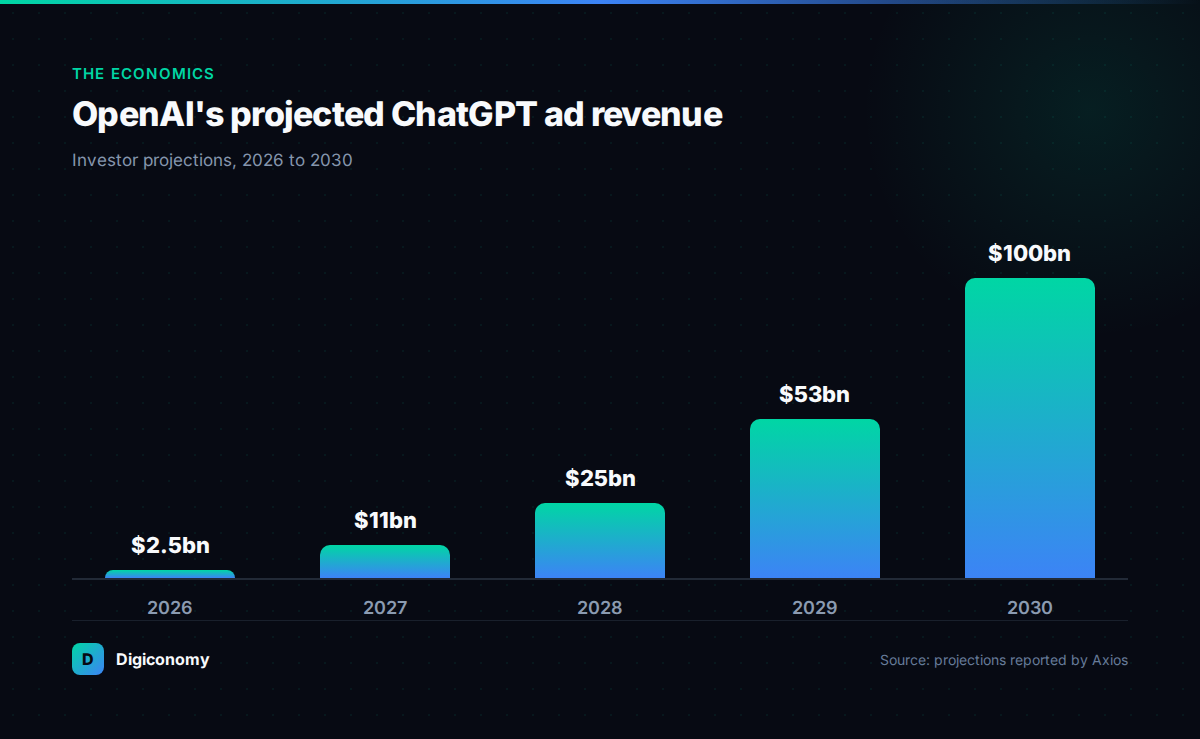
Whether the conversational surface can actually carry that volume of advertising without damaging the product is the open question hanging over the whole plan. Search results have room for many ads per page; a single answer in a chat thread does not. The projections imply either a very large user base, a high price per placement, or both, sustained over years.
Where it is live, and the UK picture
The rollout began in the United States, shown to logged-in adult users on the free and Go tiers, and has been expanding through 2026 into further markets. OpenAI has signalled that the pilot will reach the UK as part of that expansion, which would make Britain one of the first markets outside North America and Asia-Pacific to see ads inside ChatGPT.
There is an important asymmetry for British brands. UK users may begin seeing ads before UK advertisers can buy them, because the self-serve Ads Manager has not opened to UK accounts as of writing. In other words, your customers can be advertised to inside ChatGPT before you have any ability to advertise back. Reporting on exact UK timing and launch partners has varied, so the safe read is that access is coming rather than fully here, and the gap between seeing ads and being able to run them is worth planning around now.
What ChatGPT ads still cannot do
Measurement is the biggest gap. Attribution inside ChatGPT is immature compared with Google or Meta, with limited assisted-conversion logic and reporting that practitioners have described as primitive. If your team is used to granular path-to-conversion data, the current tooling will feel thin, and you will need to lean on incrementality testing and your own analytics rather than the platform's numbers.
Cost and control are the second concern. A premium CPM combined with coarse targeting controls makes it hard to justify meaningful spend against established channels on pure efficiency. The inventory is scarce, the levers are few, and the data to optimise with is limited, which is a difficult combination for anyone managing to a strict cost per acquisition.
Then there is trust, which is less a feature gap than an existential one. Critics including Google DeepMind's Demis Hassabis have questioned whether users can fully trust an assistant that also sells advertising. The entire model depends on the separation between the answer and the ad holding firm in users' minds. If that perception slips, the audience that makes the inventory valuable is the same audience that walks away.
What paid-media teams should do now
Treat ChatGPT ads as test budget, not a reallocation. Set a small, ring-fenced amount, measure it incrementally against a holdout rather than trusting platform-reported conversions, and judge it on whether it adds genuinely new demand rather than repricing clicks you would have won anyway. The channel is too young and too thinly instrumented to bet a core budget on.
Get the foundations right before you pay to appear. The brands that will do well when this inventory matures are the ones the model already understands and is willing to recommend on its own. That means making sure your business is clearly described, well cited, and easy for AI systems to reason about long before you buy a placement. Paid visibility inside an AI product tends to reward brands that already have earned visibility, not those trying to buy their way past a standing start.
The surface is new, the economics behind it are enormous, and the rules will keep changing for some time yet. None of that is a reason to pour budget in early, and none of it is a reason to ignore it. The teams that learn how the system works now - its formats, its targeting logic, and its very real limits - will be the ones spending well when it grows up.